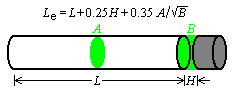
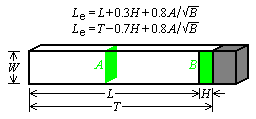
, where
c is the
speed of sound. Examples
of the most common
cases are open and stoppered organ pipes, commonly
characterized by
their working length as being half and quarter wavelength,
respectively. When such pipes oscillate at their
fundamental pitch
their internal standing wave patterns of acoustic pressure
and flow are
classically illustrated this simplified way.
, where
c is the
speed of sound. Examples
of the most common
cases are open and stoppered organ pipes, commonly
characterized by
their working length as being half and quarter wavelength,
respectively. When such pipes oscillate at their
fundamental pitch
their internal standing wave patterns of acoustic pressure
and flow are
classically illustrated this simplified way.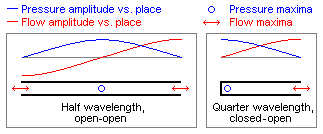
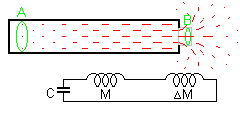
Let us initially inspect a quarter
wavelength
resonator tube of length L
and area A,
closed at one
end. This tube has a total
acoustical
mass  and acoustical capacitance
  ,
where
,
where  is density of the air
and c is its
speed of sound.
The effective resonating mass and capacitance
are less than these total
ones. They are reduced by the
factor
is density of the air
and c is its
speed of sound.
The effective resonating mass and capacitance
are less than these total
ones. They are reduced by the
factor  due to the sinusoidal distribution within the tube of
flow
and pressure. (This factor is the area of a sine
quadrant, divided by
the area of its circumscribed rectangle). Thus the effective mass is
due to the sinusoidal distribution within the tube of
flow
and pressure. (This factor is the area of a sine
quadrant, divided by
the area of its circumscribed rectangle). Thus the effective mass is  and
effective
capacitance
and
effective
capacitance  .
Inserting these into the resonance formula
.
Inserting these into the resonance formula  and
cleaning up, leads into the well known
quarter wave expression
and
cleaning up, leads into the well known
quarter wave expression  for
the fundamental
resonance.
for
the fundamental
resonance.
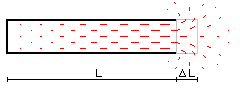
 is
called the end
correction. To compute the resonance
frequency
the length measure one should use is the sum of physical
length plus
the end correction.
is
called the end
correction. To compute the resonance
frequency
the length measure one should use is the sum of physical
length plus
the end correction.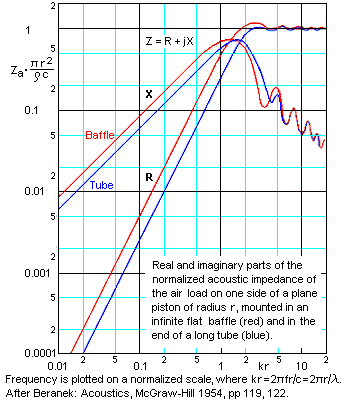
 is the
quadrature
component. The nice thing is that
is the
quadrature
component. The nice thing is that  ,
where the equivalent tube radius is
,
where the equivalent tube radius is  .
.
 There
is a paradox
in that the basic correction formula for
the
There
is a paradox
in that the basic correction formula for
the 
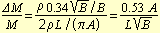
 , we
then finally arrive at
, we
then finally arrive at
 relation
was used as a
direct value for the end correction by Ising (1969),
apparently adopted
from Ingerslev and Frobenius (1947).
relation
was used as a
direct value for the end correction by Ising (1969),
apparently adopted
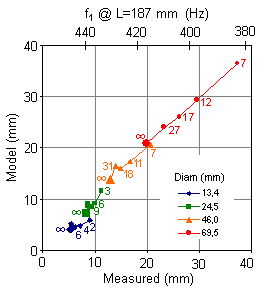
from Ingerslev and Frobenius (1947).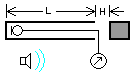 A number of
tubes with one end closed were examined for their passive
fundamental
resonances. The open ends were adjustable for variation in
cutup H.
A number of
tubes with one end closed were examined for their passive
fundamental
resonances. The open ends were adjustable for variation in
cutup H. 
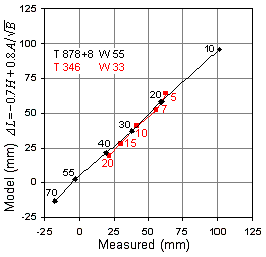
 , by trial and
error, such
that the model values (computed from A, B, and H) come
maximally close
to the experimental ones.
, by trial and
error, such
that the model values (computed from A, B, and H) come
maximally close
to the experimental ones.