A
classical air dump tremulant, in the form found in
Wurlitzer theatre pipe organs is described. An attached
special purpose
Windows
PC program simulates its acoustic network.
Here several design and adjustment
parameters can be interactively manipulated, leading to detailed
computed
pressures and airflows throughout the system. This may be an
aid to understand and master a trem installation. You can also
study the dynamic effects from the supply trunk when playing
with the tremulant turned off.IntroductionThe tremolo effect, a periodic modulation of amplitude and frequency, is done in a pipe organ by modulating the wind chest pressure. The device for this purpose is called a tremulant, colloquially a trem. The primary goals for trem adjustment is to set a proper rate, typically around 7 Hz, and depth, the relative variation in pressure. Other requirements are that the effect should start smoothly when turned on, and that it should not be too influenced from the number of simultaneously speaking pipes on the chest.A common trem implementation is a self-oscillating bellows and pallet mechanism, connected by a trunk to the wind chest. When this mechanism operates it dumps periodic puffs of air from the chest. This type of tremulant is notoriously known to be difficult to adjust, and is also somewhat wasteful with air supply. Because of this, naturally, several competing principles for tremulants exist in the organ world. One part of the problem to install a trem is to decide dimensions of trunks and bellows, another is to set its adjustable valves and weights. The present simulation may be a support, both in planning and maintenance work. |
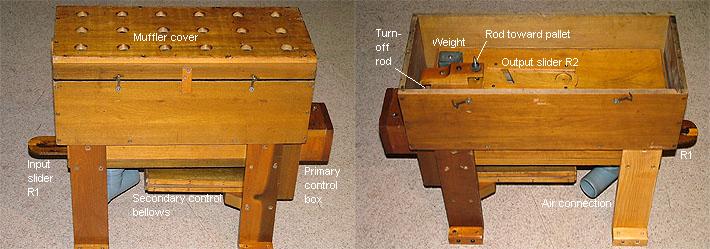
A Wurlitzer tremulant![]() Fig 1. A small Wurlitzer tremulant. Left complete, right with muffler cover removed. |
| The tremulant mechanism proper
is enclosed in a box where input air is connected at the bottom, where
an input slider sets an input aperture. The mechanism, detailed below,
is normally covered by a felt filled muffler with several exhaust holes
on top. This is to attenuate the periodic noise bursts coming from air
escaping from the output slider. Below the trem box is a control
machinery to turn the trem on or off. This is in form of a magnet
valve,
a primary valve, and a comparatively large secondary control bellows. |
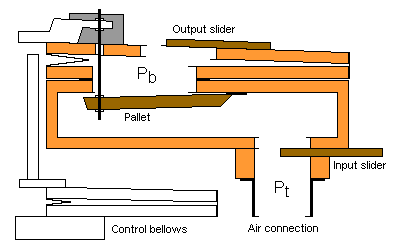
Short description of the trem functionWith the bottom control bellows inflated the mechanism is at rest. Then the upper bellows lid is lifted and the pallet is held closed such that no air can enter at the trunk connection.To start the tremulant the control bellows is evacuated. This allows also the upper trem bellows to collapse from its own weight and the pallet will begin opening. As the pallet opens there is an increasing flow into the bellows. The ultimate flow is however not limited by the pallet, but is restricted by the aperture of the input slider. |
|
Fig 2.
Simplified drawing of
the trem interior. |
| The flow rate and the aperture of the output slider define an internal pressure Pb gradually building up. When this pressure is large enough the bellows is inflated again, driving the pallet to close eventually. When this happens there will be a temporary peak in the input pressure Pt by the 'hydraulic hammer' effect from the flowing air column in the trunk being abruptly stopped as the pallet slams shut. This pressure peak is higher than the supply pressure to the organ. After some time this pressure pulse will die out and we are ready for another cycle where the bellows can collapse again from its own weight |
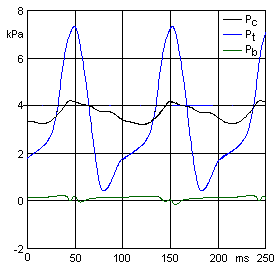
![]() Fig 3. Measured pressure waveforms in a small Wurlitzer tremulant. |
The
waveforms of fig. 3 were measured individually with a pressure
transducer on a small Wurlitzer tremulant, supplied from a 50 mm dia.
tube, 2 m long, connected directly to a fan. Their relative timing is
not warranted, but a few preliminary observations can be made. The pressure Pc at the feeding end of the trunk oscillates reasonably around the about 3.6 kPa (14inWC) supply. Not much can be said about the magnitude of the variations since nothing is known of the feeding impedance. The Pt trace at the input of the trem, at the opposite end of the trunk, shows very large variations, from very low up to about twice the supply. This demonstrates the 'hydraulic hammer' effect and suggests that the trunk has a profound effect on the trem function. The pressure difference across the pallet varies very much. As a contrast Pb inside the trem bellows is always very low, maybe to a surprise, nowhere near the organ operating pressure. With its fairly large lid area, little pressure is needed to raise its weight. |
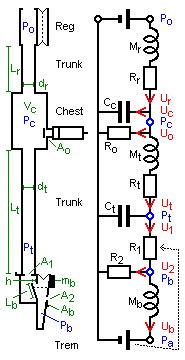
| For simulation of the system an
analog network was developed as in fig. 4. Left is a stylized
drawing of the physical system with relevant dimensions indicated in
green. Blue symbols indicate pressures at a few places. The correspondent analog diagram is shown at right. This has symbols borrowed from electrical technology, though all its elements in our case are acoustical. The purpose of that diagram is to formalize which ways the different airflows U will take, and to visualize how you can compute partial pressure differences from the flows passing the various impedance elements, denoted in black. The most basic method here is to apply Ohm's law in acoustical terms. This law is Pressure=Flow*Impedance, in analogy to the electrical case where Voltage=Current*Impedance. For an interested reader further technical detail is developed in the appendix below. All is driven from a supply regulator by the pressure Po which is taken to be constant. An airflow Ur is fed by a trunk of length Lr and diameter dr to the wind chest of volume Vc. Ao is an open area from the chest representing the flues of any speaking pipes that together consume flow Uo. Uc is the flow taken to compress the chest volume of air in case its internal pressure Pc should vary. The next trunk of length Lt and diameter dt is terminated at the trem input slider of area A1. The product of pallet opening h and length Lb represent the pallet opening area. The smaller of this and A1define a resistance R1 against flow U1 to enter the trem bellows where pressure is Pb. A2 is the area of the trem output slider, with R2 taking the output flow U2. The mass mb and area Ab of the bellows result in an inertial element Mb, and in the same time contributes to a counter pressure Pa. Pallet excursion h is computed from Ab and the time integral of Ub. |
|
![]() Fig 4. General layout, symbols, and analog acoustical circuit for the trem system. |
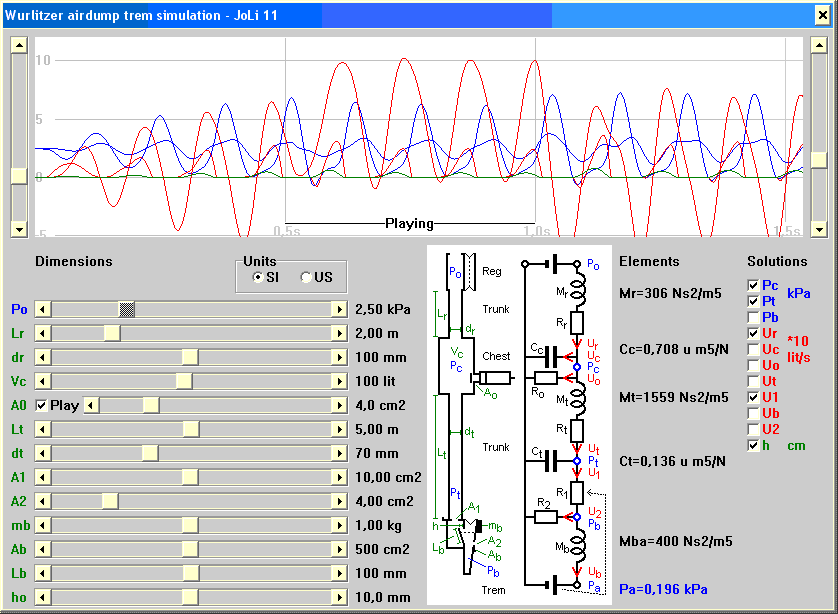
Simulation programThe attached Windows PC simulation program (trem.exe) was written in Borland Delphi Pascal. It presents a screen with numerous scrollbars at the left side, where you can input physical dimensions. With radio buttons you can select whether to see these inputs in SI units or in traditional US, but computations and result reports are done in SI throughout. In the middle of the screen fig. 4 is reproduced as an orientation aid. It is supplemented with resulting values of those impedance elements that are constant, essentially the masses and compliances. The resistance elements vary nonlinearly with flows throughout the simulation time span, which is 1.5 seconds. The nonlinearity in itself could make simulation next to impossible, but this problem is circumvented by a simple minded approximation explained below. At top is an image area to show results as graphs vs. time for the various pressures and flows. Here the zero line and scale can be adjusted with scrollbars. Check boxes at right are used to select which data to display.Disclaimer: The results of this simulation are believed to be reasonably accurate in quantity, but cannot be guaranteed. In assessing element values for the simulation, the formulas used are in their most basic form, taken from the classical literature, like eqs. (3) and (6) - (8) below. More refined side effects are not accounted for, e.g. like end corrections or bends in a trunk. The discrete time simulation method in itself is approximate, and finally there is some risk from mistakes by the author. The reader is encouraged to run the program, to modify input dimension parameters at will, and to look at the various result graphs to familiarize with the trem operations. |

| Normally the A0 parameter is zero,
disregarding what the scrollbar says, no air is consumed from the chest
to play any pipes. This changes when you press the Play button
beside. Then, in the time interval from 0.5 to 1.0 seconds, the
scrollbar value for A0
open area takes effect. This is to show pressure drop and other things
change when the chest is temporarily loaded. You can use this button to
see what happens when playing,
also when the trem
is not used. The natural way to
turn the trem off is to pull the mb
parameter down to
zero. |
|
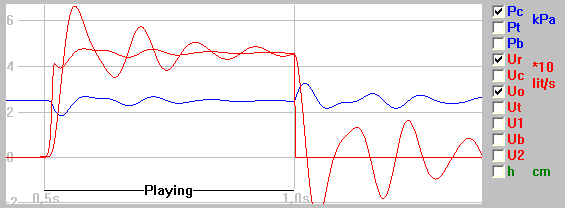
![]() Fig. 6. Example of playing with the trem off. The trunk and the chest form a Helmholtz resonator that is excited by the changes in Uo. |
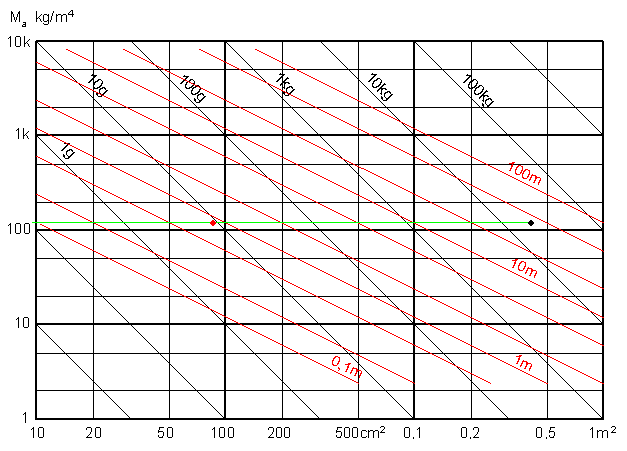
DiscussionIn an existing installation most parameters like trunk and trem bellows dimensions are already given. Then you can examine what happens when changing the parameters A1, A2, and mb supposed to be the normal parameters for an adjustment.The regulator in this simulation is assumed to be perfect in delivering a constant driving pressure. A practical one may vary somewhat in static output with its reservoir fill, depending on how its bellows and spring/weight load match. This is a different problem that should have minor influence, not accounted for here. Another factor is the inertia of the regulator, manifest in its acoustical mass which is found from reservoir lid area and loading weight using eq. (7) below. Knowing that value you can approximate its effect by adding it to Mr by an increase in the trunk length Lr. Example
calculation: With a
regulator lid weight m = 15
kg, area A = 0.38 m2,
its
acoustical mass is M = m/A2
= 15/0.382 = 104 Ns2/m5, about one
third of Mr in fig
5. You can account for it by elongating the trunk about 0.3 m.
The net airflow consumption of the trem is U2 which has a waveform reminding of half sinusoids, skewed to the right. This shape is typical for many airflow interrupting devices like reed pipes, diaphones, orchestral reed and brass instuments, and the human glottis. Indeed the whole trem system can be likened to a diaphone pipe, blown backwards from its mouth at the supply regulator. Like in the mentioned examples the pulse flow from the interrupter is connected to a resonator, in our case the trunks and the chest, to produce an amplified flow oscillation Ur at the mouth, and which may reach quite high values. It should be noted that part of a trem cycle this flow goes backwards to refill the regulator. The regulator is supposed to deliver a constant pressure Po. Even when it manages to do so, its bellows lid will oscillate because of the alternating Ur. Following the lid, the regulator input valve will also oscillate. |
![]() Fig. 7. Cutout from the screen, with same parameter settings as in fig 5, but different data displayed. |
|
Example
calculation: With Ur
about sinusoidal 50 lit/sec peak/peak at 8 Hz, then the volume
displacement
in the regulator will be U/(2π
*f) = 50/(2π*8)
= 1.0 lit p/p. That renders a lid
oscillation about 2.6 mm p/p when the lid area is
0.38 m2. The pressure Pt at the trem input varies much more than the chest pressure. There is a sharp pressure rise when the pallet closes. This starts a resonance oscillation inside the trem trunk that causes a secondary peak, as seen in fig. 7. The trem bellows flow Ub makes excursions, negative and positive, enclosing the same areas in the time-flow plane. The pallet excursion h is proportional to the integral of this flow. |
|
The useful part of the trem flow
is Uc
that compresses and rarifies the chest volume, producing the desired
modulation in Pc.
Knowing a quarter wave resonator for 7 Hz to have a length about 12 m,
it is tempting to expect this to be an optimal Lt. The trem trunk would
then be assumed to be an isolated resonator amplifying the pulses into
the
chest. This is not justified, because the other mass components are
firmly coupled. Together they force a much lower resonance than for
that
trunk alone. Also, the
inertia from Mr
of the supply trunk is a valuable
obstacle for flow oscillation to reach the regulator. It is useless and
wasteful to connect the trem directly to the regulator rather than to
the chest. The chest pressure variations would then be small, to
the extent the regulator can do its work. For efficiency in the trem an
opposite design is relevant. The regulator to chest trunk should then
be
fairly long, and as narrow as possible without starving necessary
feed to the chest. Then a major portion of the
oscillatory part of the flow Ut
from the trem will remain in the chest, and not so much of the chest
pressure ondulation is lost upstream into the regulator.
Several, if not all parameters have limited ranges outside which the trem device no longer works. These ranges are defined by usually several of the other parameters. To take a simple example, the supply pressure Pr together with pallet dimensions and trem bellows area set a lower limit for bellows weight mb. This must be large enough to open the pallet against the supply pressure. A main purpose behind this simulation is to show how total performance is modified, whichever parameter you select to change. But, despite this set up uses scientific methods, the experimenter should be aware of the proverb: |
| To control a system with more than six parameters is art, not science. |
Appendix: Simulation proceduresThe following section is highly technical and is probably interesting only to a reader familiar to circuit theory.Initially at time zero all variables are known, pressures either Po or zero, all flows are zero. From all the known elements and variables an equation system is set up, using an extended variant of Ohm's law, namely the Kirchhoff laws: - Going around each mesh in the network, the motive pressure equals the sum of flows times impedances. - For each node the sum of entering flows is zero. This rendered five mesh equations and two node equations for this network, excluding the almost trivial one with pressure Pt. In total a system of 7 equations for 7 unknown flows U, illustrated in Tab.1 below. The equation system is then solved using a standard Gauss-Jordan algorithm. From that all the flows U become known, and it is simple to update the pressures Pc, Pt, and Pb, directly from eq. (2) below. It would work just as well to include these pressure expressions as part of a bigger 10*10 equation system, but the solution algorithm would then take some more time to perform. Had all parameters been constant and the elements been resistive, then this result would have been stationary and final. But this is not case since the pressures across the reactive M and C elements depend also of time. The impedance expressions for reactive components contain time derivatives or integrals of flow. So the basic principle used here is time stepping with a small time interval τ. For an acoustic mass the pressure across it is mass times the time derivative of flow, P=M*dU/dt. That is here approximated in difference form as P
= M * (U - U) /
τ
(1).
The strikethrough denotes the known value from the previous computation
round, so the time derivative is taken as(change in flow)/(time step). In the same spirit, for a compliance element C the integration of flow U renders a pressure across it P
= P + U * τ / C .
(2)
During the time slot a small volume U
* τ enters the compliance element.
Dividing this by C gives the
corresponding
increment in pressure, adding to the hitherto existing pressure P .The solution gives new values for the U and P variables, valid for a new time, one interval τ later. Having come that far all resistances R are re-computed, based on flow values from the previous step, now labelled U . The 7 equations thus contain several values of P and U , known from the previous computation cycle. This cycle of setting up the equation coefficients and solving is iterated, keeping record of the solutions for display afterwards. When any of the input parameters is changed, the program runs 768 iteration cycles with τ = 0.002 sec to cover the waveform development from start to just over 1.5 seconds. Such an entire round is computed in a small fraction of a second. |
| # |
*Ur | *Uc | *Uo |
*Ut |
*U1 |
*Ub |
*U2 |
= |
| 1 |
Mr/τ+Rr | τ/Cc |
Po-Pc+MrUr/τ | |||||
| 2 |
-τ/Cc | Ro |
Pc |
|||||
| 3 |
-Ro | Mt/τ+Rt+τ/Ct | -τ/Ct | MtUt/τ-Pt | ||||
| 4 |
-τ/Ct | τ/Ct+R1 |
R2 |
Pt | ||||
| 5 |
Mb/τ | -R2 | MbUb/τ-Pa |
|||||
| 6 |
-1 |
+1 |
+1 |
+1 |
0 |
|||
| 7 |
-1 |
+1 |
+1 |
0 |
| Tab.
1. The seven network equations
used in the simulation, displayed in a matrix like way. Eq. # 1-5 are mesh equations, # 6-7 are
node equations. Clarifying example: Fully written out eq #5 for the last mesh would read (Mb/τ)*Ub - R2*U2 = MbUb/τ - Pa , which is rearranged from the original mesh equation, going clockwise, in form Mb*(Ub - Ub)/τ - R2*U2 = - Pa . |
Acoustical elementsThe three basic element types are resistances R, masses M, and compliances C. The following describes how these are handled in the simulation. SI units are used throughout this section. The air properties are taken as:ρ
= 1.2 kg/m3
density,
c = 343 m/s speed of sound. Resistances RA flow U through a linear resistance R develops a pressure across it: P = R * U. A major difficulty in the current problem is that the resistances are non-linear, the resistances themselves are functions of U. This makes it impossible to solve the system equations accurately unless you resort to iterative methods. Since this would complicate simulations beyond reason a simple minded approximation was used, namely to estimate resistance values for the next time step using the past, already known U. Often this works well, when flows do not change appreciably from one time slot to the next. But this is not always true, in particular when the pallet closes, so occasionally this can make computations break down from instability. The remedy here is to average also a newly estimated R with its previous value R. Special care must be taken when an aperture area approaches zero, the resulting resistance is then forced to a large, but finite value.Two kinds of resistance elements are encountered: Resistance of a constricting orifice. This applies to the pallet and the adjustment sliders. With flow U through area A, the Bernoulli law tells the pressure drop P
= 0.5 * ρ
* ( U / A )2.
[Pa = N/m2]
(3)
This renders
a resistance R
= P / U = 0.5 * ρ * |U |/ A2 [Ns/m5]
(4)
Since resistance is positive, irrespective of flow direction, it is important to use the absolute value |U| of the flow when a resistance is estimated this way. Otherwise the resistance would become negative, should flow direction reverse. Such non-physical behavior is a trigger of instability and collapse of a simulation. Resistance in a trunk. This applies to the chest and trem trunks. From a classical HVAC engineering diagram of pressure drop per length vs. flow and diameter I arrive at the approximate empirical formula R
= 0.0244 * L * |U| / d5
(5)
It may be interesting to note that for a duct, 40 diameters long, the
orifice and trunk formulas give the same result.Masses MThe acoustical mass of air in a trunk isM
= ρ * L / A
[Ns2/m5]
(6)
The mechanical mass mb [kg] of the trem bellows lid, having the area Ab [m2] is converted into acoustical mass by Mb
= mb / Ab2
[kg/m4 = Ns2/m5]
(7)
Compliances CThe acoustical compliance of a volume V isC
= V / ( ρ * c2 ) [m5/N]
(8)
TrunksA trunk is a transmission line, generally represented in network theory with a chain of links. Each link has a series M component and a shunt C component for a corresponding lengthwise segment of the line. They are possibly supplemented with resistance elements to account for losses, as done here with Rr and Rt. M and C are computed for the air enclosed in a segment as in eqs. (6) and (8) above. In this simulation the shunt C element of the supply trunk is not visible in the diagram, it is taken to be a minor part of the chest compliance Cc.This representation is valid for low frequencies only, a segment should be shorter than a quarter wavelength in the signal transmitted. In this simulation the trunks are represented by only one single MC link each, and the maximum length you can set is 10 m. In that extreme case the critical frequency comes down as low as into the 10 Hz range, so waveform details are then not overly reliable. |
The pallet
To handle the pallet requires a few tricks, additional to the problem
of estimating its flow resistance R1.
The pallet opening h is found
from integrating the flow Ub
into the trem bellows. When h
goes down to zero the lid motion is abruptly stopped. In the simulation
then Ub
is then forced to zero, with no further care of any
mechanical side effects, like e.g. a bounce against the seat. The
expedient to eventually open the pallet is the pressure Pa
derived from the lid weight and area. This term enters at the right
hand side of eq. # 5 in Tab.1. This
is additionally corrected for the opposing pressure difference Pt-Pb operating across the
pallet. The correction is that difference, geared down by the factor
0.25*Lb2/Ab.
That is, pallet area divided by bellows lid area, and where the
pallet width is arbitrarily assumed to be one quarter of its length. |
2009-02-15 |